
FAS Detection
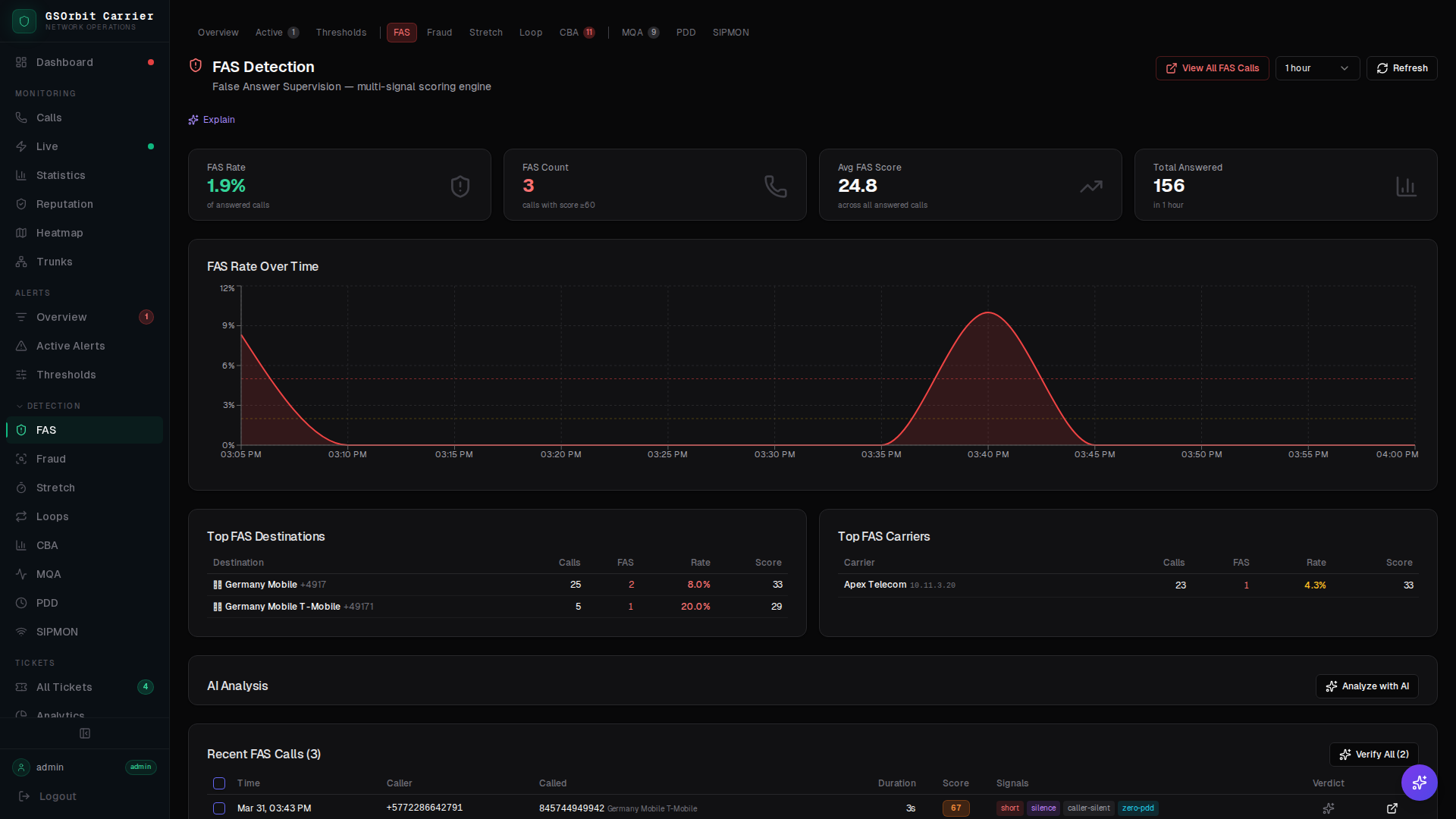
False Answer Supervision fraud costs carriers millions annually. GSNOC combines CDR signal analysis with audio extraction and AI classification to detect FAS with evidence you can use in carrier disputes.
The FAS Problem
False Answer Supervision occurs when a carrier marks a call as answered and starts billing before the called party actually picks up — generating revenue from silence, tones, or synthetic audio.
- Direct financial loss — you pay for calls that were never actually answered
- Inflated ASR statistics masking a carrier's true connection quality
- Difficulty disputing charges without audio evidence to prove the call was not answered
- Repeated FAS from the same carrier eroding margin on high-volume routes
How FAS Detection Works
A four-stage pipeline combines statistical CDR analysis with audio verification and AI confidence scoring.
Calls billed as answered but lasting under a configurable threshold are flagged as FAS candidates for audio extraction.
RTP streams for candidate calls are extracted from captured PCAP data and prepared for analysis.
Extracted audio is analyzed for the presence of genuine speech versus silence, tones, or synthetic audio content.
A trained classifier assigns a FAS confidence score based on duration, audio content, carrier pattern history, and time-of-day context.
Why GSNOC FAS Detection Is Different
- Audio verification provides actual proof — not just CDR statistics — that a call was not genuinely answered
- AI confidence scoring lets you prioritize disputes by severity rather than chasing every short-duration call
- Per-carrier FAS rate tracking identifies systematic fraud versus isolated incidents
Key Metrics
Percentage of billed calls classified as false answer supervision per carrier
AI confidence score (0–100) that audio content indicates FAS rather than genuine answer
Billed call duration for FAS-flagged calls — shorter durations with answer billing are stronger signals
Time from call initiation to answer signal — abnormally short answer delays are a FAS indicator