
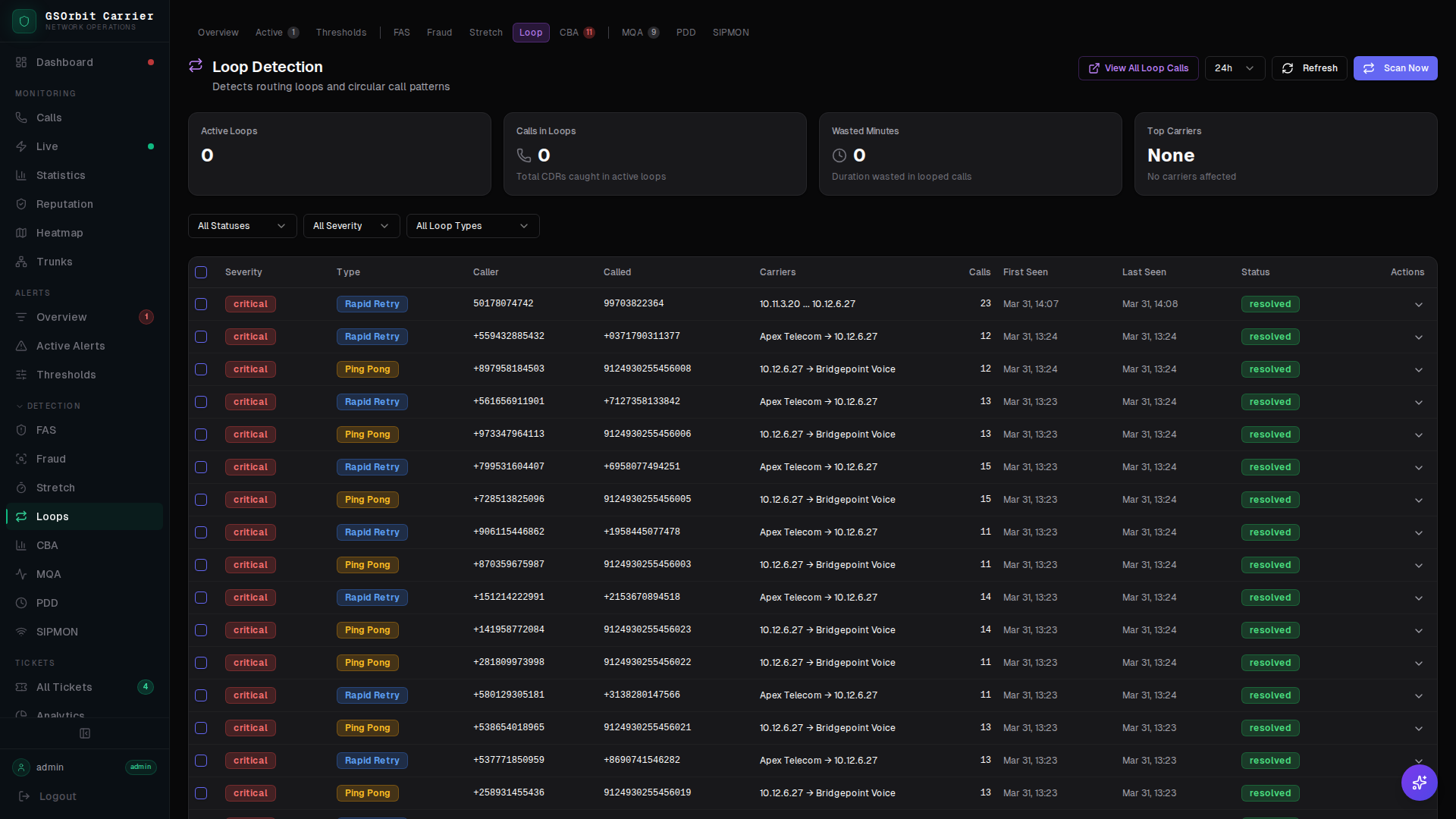
Loop Detection
Routing loops occur when a call traverses the same carrier more than once, consuming channel capacity without delivering service. GSNOC detects both simple two-carrier loops and complex multi-carrier chains in real time.
The Routing Loop Problem
Loops in VoIP routing consume channels, inflate CDR counts, and can cascade into capacity exhaustion. They are often invisible until a circuit fills up — by which point legitimate calls are already being dropped.
- Routing loops consuming channel capacity that should be available for legitimate calls
- Ghost calls appearing in CDRs — calls that look active but carry no real conversation
- Cascading failures when looped calls exhaust available channels and block new call attempts
- Inflated billing from carriers charging for looped call legs that delivered no value
How Loop Detection Works
GSNOC traces call routing paths across carrier signaling data to identify circular routes in real time.
Identifies carrier IP pairs that appear multiple times in a single call's routing path — the simplest indicator of a two-carrier loop.
Reconstructs the full routing chain for each call using SIP signaling headers to identify longer loops involving three or more carriers.
Correlates sudden channel volume spikes with loop detection events to estimate capacity impact before a circuit fills.
Flags unusually long-duration calls on routes where calls should complete quickly — a secondary signal of looped traffic consuming channels.
Why GSNOC Loop Detection Is Different
- Detects both two-carrier loops (simple IP pair repetition) and multi-carrier loops (complex routing chains)
- Real-time detection with capacity impact estimation lets you act before channels are exhausted
- Loop events are correlated with carrier health scores and open tickets for full operational context
Key Metrics
Number of active routing loops detected across all carrier interconnects
Carrier IP addresses participating in detected loops
How long a loop has been active — longer loops indicate a persistent routing misconfiguration
Estimated channel capacity consumed by looped calls that could be serving legitimate traffic